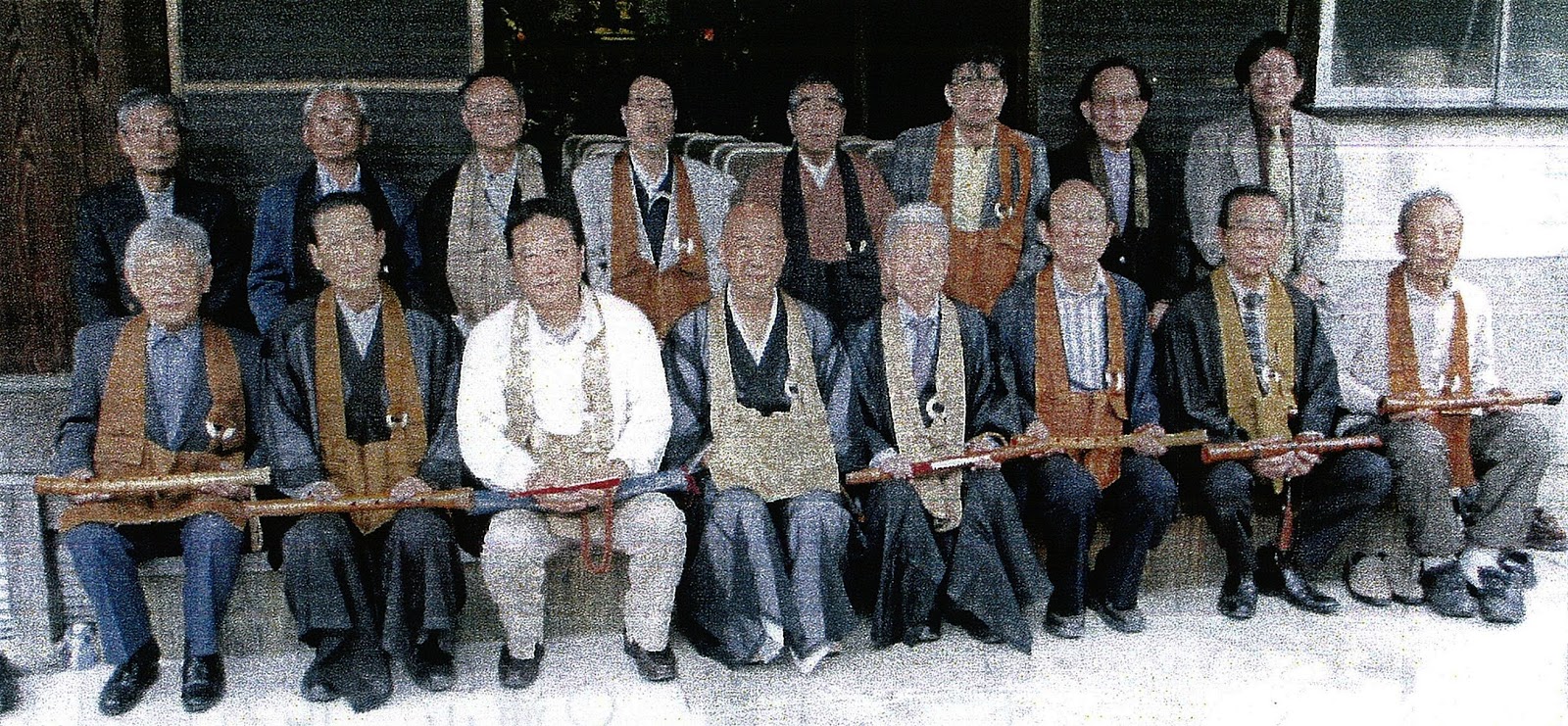
Finished in the year 1021, this first novel and masterpiece of world literature, provides many evocative examples of period music in old Kyoto. The following excerpts specifically mention the period flute in context, beginning with the chapter named "The Flute":
Chapter 37—The Flute
She gave him a flute as he left.
“It is said to have a rich past. I would hate to have it lost among these
tangles of wormwood. You must play on it as you leave and drown out the calls
of your runners. That would give me great pleasure.”
“Far too valuable an addition to my retinue.”
It did indeed have a rich past. It had been Kashiwagi’s favorite. Yūgiri had
heard him say more than once that it had possibilities he had never done
justice to, and that he wanted it to have an owner more worthy of it. Near
tears once more, he blew a few notes in the banjiki mode, but did not
finish the melody he had begun.
“My inept pluckings on the koto may perhaps be excused as a kind of
memorial, but this flute leaves me feeling quite helpless, wholly inadequate.”
The old lady sent out a poem:
“The voices of insects are unchanged this autumn,
Rank though the grasses be round my dewy lodging.”
He sent back:
“The melody is as it always was.
The voices that mourn are inexhaustible.”
…………..
He blew a soft strain on his new flute. And what would the
princess be thinking in the wake of their interview? Would she indeed, as he
had requested, leave the koto and the other instruments in the same tuning? Her
mother was said to be very good on the Japanese koto.
…………
He dozed off and dreamed that Kashiwagi was beside him, dressed as on their
last meeting. He had taken up the flute. How unsettling, Yūgiri said to
himself, still dreaming, that his friend should still be after the flute.
“If it matters not which wind sounds the bamboo flute,
Then let its note be forever with my children.
“I did not mean it for you.”
Yūgiri went on thinking about the dream. The flute was
threatening to raise difficulties. Kashiwagi was still attached to it, and so
perhaps it should have stayed at Ichijō. It should not, in any case, have been
passed on to Yūgiri by a woman. But what had Kashiwagi meant, and what would he
be thinking now? Because of the regret and the longing he must wander in
stubborn darkness, worrying about trifles. One did well to avoid such
entanglements.
He had services read on Mount
Otagi and at a temple favored by
Kashiwagi. But what to do about the flute? It had a rich history, the old lady
had said. Offered immediately to a temple it might do a little toward the
repose of Kashiwagi’s soul. Yet he hesitated.
………
The moment seemed ripe. Coming a little closer, he described his dream.
Genji listened in silence and was not quick to answer. It did of course mean
something to him.
“Yes, there are reasons why I should have the flute. It belonged to the
Yōzei emperor and was much prized by the late Prince Shikibu. Remarking upon
Kashiwagi’s skills, the prince gave it to him one day when we had gathered to
admire the hagi. I should imagine that the princess’s mother did not
quite know what she was doing when she gave it to you.”
Chapter 1
I need not speak of his accomplishments in the compulsory subjects, the
classics and the like. When it came to music his flute and koto made the heavens
echo — but to recount all his virtues would, I fear, give rise to a suspicion
that I distort the truth.
On evenings when there was music, he would play the flute to her koto and so
communicate something of his longing, and take some comfort from her voice,
soft through the curtains.
Chapter 2
He proceeded briskly to the veranda and took a seat near the gate and looked
up at the moon for a time. The chrysanthemums were at their best, very slightly
touched by the frost, and the red leaves were beautiful in the autumn wind. He
took out a flute and played a tune on it, and sang’The Well of Asuka’ and
several other songs. Blending nicely with the flute came the mellow tones of a
japanese koto. It had been tuned in advance, apparently, and was waiting. The ritsu
scale had a pleasant modern sound to it, right for a soft, womanly touch from
behind blinds, and right for the clear moonlight too. I can assure you that the
effect was not at all unpleasant.
-----------
“‘Excuse me for asking. You must not be parsimonious with your music. You
have a by no means indifferent listener.’
“He was very playful indeed. The woman’s voice, when she offered a verse of
her own, was suggestive and equally playful.
“‘No match the leaves for the angry winter winds.
Am I to detain the flute that joins those winds?’
“Naturally unaware of resentment so near at hand, she changed to a Chinese
koto in an elegant banjiki. Though I had to admit that she had talent,
I was very annoyed. It is amusing enough, if you let things go no further, to exchange
jokes from time to time with fickle and frivolous ladies; but as a place to
take seriously, even for an occasional visit, matters here seemed to have gone
too far. I made the events of that evening my excuse for leaving her.
Chapter 5
They took seats on the moss below the rocks and wine was brought out.1t was
a pleasant spot, beside cascading waters. Tō no Chūjō took out a flute, and one
of his brothers, marking time with a fan, sang “To the West of the Toyora
Temple.” They were handsome young
men, all of them, but it was the ailing Genji whom everyone was looking at, so
handsome a figure as he leaned against a rock that he brought a shudder of
apprehension. Always in such a company there is an adept at the flageolet, and
a fancier of the shō pipes as well.
The bishop brought out a seven-stringed Chinese koto and pressed Genji to
play it. “Just one tune, to give our mountain birds a pleasant surprise.”
Chapter 6
Getting into the same carriage, they played on their flutes as they made
their way under a pleasantly misted moon to the Sanjō mansion. Having no
outrunners, they were able to pull in at a secluded gallery without attracting
attention. There they sent for court dress. Taking up their flutes again, they
proceeded to the main hall as if they had just come from court. The minister,
eager as always for a concert, joined in with a Korean flute. He was a fine
musician, and soon the more accomplished of the ladies within the blinds had
joined them on lutes.
………
Indeed the house quite rang with music, and flute and flageolet sounded
proud and high as seldom before. Sometimes one of them would even bring a drum
up from the garden and pound at it on the veranda. With all these exciting
matters to occupy him, Genji had time for only the most necessary visits; and
so autumn came to a close.
Chapter 7
The forty men in the flutists’ circle played most marvelously. The sound of
their flutes, mingled with the sighing of the pines, was like a wind coming
down from deep mountains. “Waves of the Blue
Ocean,” among falling leaves of
countless hues, had about it an almost frightening beauty.
……..
Rumpled and wild-haired, he played a soft strain on a flute as he came into
Murasaki’s room
……..
After plucking a few notes to see that it was in tune, he pushed it toward
her. No longer able to be angry, she played for him, briefly and very
competently. He thought her delightful as she leaned forward to press a string
with her left hand. He took out a flute and she had a music lesson. Very quick,
she could repeat a difficult melody after but a single hearing. Yes, he
thought, she was bright and amiable, everything he could have wished for.
“Hosoroguseri” made a pretty duet, despite its outlandish name.
Chapter 12
He had brought gifts from the city, both elegant and practical. Genji gave
him in return a black pony, a proper gift for a traveler.
“Considering its origins, you may fear that it will bring bad luck; but you
will find that it neighs into the northern winds.”
It was a fine beast.
“To remember me by,” said Tō no Chūjō, giving in return what was recognized
to be a very fine flute. The situation demanded a certain reticence in the
giving of gifts.
…….
It was winter, and the snowy skies were wild. He beguiled the tedium with
music, playing the koto himself and setting Koremitsu to the flute, with
Yoshikiyo to sing for them. When he lost himself in a particularly moving
strain the others would fall silent, tears in their eyes.
Chapter 13
Genji played on in a reverie, a flood of memories of concerts over the
years, of this gentleman and that lady on flute and koto, of voices raised in
song, of times when he and they had been the center of attention, recipients of
praise and favors from the emperor himself. Sending to the house on the hill
for a lute and a thirteen-stringed koto, the old man now seemed to change roles
and become one of these priestly mendicants who make their living by the lute.
He played a most interesting and affecting strain. Genji played a few notes on
the thirteen-stringed koto which the old man pressed on him and was thought an
uncommonly impressive performer on both sorts of koto. Even the most ordinary
music can seem remarkable if the time and place are right; and here on the wide
seacoast, open far into the distance, the groves seemed to come alive in colors
richer than the bloom of spring or the change of autumn, and the calls of the
water rails were as if they were pounding on the door and demanding to be
admitted.
Chapter 17
“Father was tutor for all of us, but I thought he took himself seriously
only when you were his pupil. There was poetry, of course, and there was music,
the flute and the koto. Painting seemed less study than play, something you let
your brush have its way with when poetry had worn you out. And now see the
results. See all of our professionals running off and hiding their faces.”
Chapter 18
As moonlight flooded the scene the music was more bois- terous, dominated by
the flute, there being several fine flutists in the company. The stringed
instruments were quieter, only the Japanese koto and the lute. The flute is an
autumn instrument, at its best in the autumn breezes. Every detail of the
riverbank rose clear and high and clean in the moonlight. A new party arrived
from the palace, from the royal presence itself, indeed. The emperor had been
much disappointed that Genji had not called at the end of the week-long retreat
from which the court had just emerged. There was music once more, and surely,
thought the emperor, Genji would appear.
Chapter 21
“How very nice,” said Tō no Chūjō, motioning him to a place at the girl’s
curtains. “We do not see as much of you these days as we would like. You are so
fearfully deep in your studies. Your father knows as well as I do that too much
learning is not always a good thing, but I suppose he has his reasons. Still it
seems a pity that you should be in solitary confinement. You should allow
yourself diversions from time to time. Music too has a proper and venerable
tradition, you know.” He offered Yūgiri a flute.
……
Prince Hotaru filled the emperor’s cup and offered this poem:
“The tone of the flute is as it always has been,
Nor do I detect a change in the song of the warbler.”
It was very thoughtful and tactful of him to suggest that not all was
decline.
With awesome dignity, the emperor replied:
“The warbler laments as it flies from tree to tree —
For blossoms whose hue is paler than once it was?”
Chapter 23
They went from the main palace to the Suzaku
Palace of the retired emperor and
thence to Rokujō. The way being a long one, it was dawn when they arrived. A
moon hung in a cloudless sky and a light fall of snow set the garden off to
weirdly delicate effect. Everyone wanted to be his best when he came to Rokujō.
It was an age well provided with fine musicians, and the sound of flute rang
high through the grounds.
Chapter 24
It was night, and they seemed indefatigable. Flares having been put out in
the garden, they were invited to the moss carpet below the verandas, and the
princes and high courtiers had places above with the kotos and flutes in which
they took such pride. The most accomplished of the professional flutists struck
up a melody in the sōjō mode, in which the courtiers joined most brilliantly
with their kotos, and as they moved on to “How Grand the Day” even the most
ignorant of the footmen off among the horses and carriages seemed to respond.
The sky and the music, the spring modes and echoes, all seemed better here — no
one could fail to see the difference. The night was passed in music. With “Joy
of Spring” the mode shifted to an intimate minor. Prince Hotaru twice sang
“Green Willow,” in very good voice. Genji occasionally
Chapter 27
“You wish me to go?” But someone in the other wing had taken up a flute,
someone who knew how to play, and there was a Chinese koto too. “Yūgiri is at
it again with those inseparable companions of his. This one will be Kashiwagi.”
He listened for a time. “There is no mistaking Kashiwagi.”
He sent over to say that the light of the flares, cool and hospitable, had
kept him on. Yūgiri and two friends came immediately.
“I felt the autumn wind in your flute and had to ask you to join me.”
His touch on the koto was soft and delicate, and Yūgiri’s flute, in the
banjiki mode, was wonderfully resonant. Kashiwagi could not be persuaded to
sing for them.
“You must not keep us waiting.”
His brother, less shy, sang a strain and repeated it, keeping time with his
fan, and one might have taken the low, rich tones for a bell cricket
Chapter 32
It was the eve of the ceremony. The stewards’ offices had brought musical
instruments for a rehearsal. Guests had gathered in large numbers and flute and
koto echoed through all the galleries. Kashiwagi, Kōbai, and Tō no Chūjō‘s
other sons stopped by with formal greetings. Genji insisted that they join the
concert. For Prince Hotaru there was a lute, for Genji a thirteen-stringed
koto, for Kashiwagi, who had a quick, lively touch, a Japanese koto. Yūgiri
took up a flute, and the high, clear strains, appropriate to the season, could
scarcely have been improved upon. Beating time with a fan, Kōbai was in
magnificent voice as he sang “A Branch of Plum.” Genji and Prince Hotaru joined
him at the climax. It was Kōbai who, still a court page, had sung “Takasago” at
the rhyme-guessing contest so many years before. Everyone agreed that though
informal it was an excellent concert.
……….
Kashiwagi recited this poem as he poured for Yūgiri:
“Sound your bamboo flute all through the night
And shake the plum branch where the warbler sleeps.”
……..
Genji gave the chamberlain a fine Korean flute and specimens of Chinese
patchwork in a beautifully wrought aloeswood box.
Chapter 33
He was unsurpassed on the flute. Among the courtiers who serenaded the
emperors from below the stairs Kōbai had the finest voice. It was cause for
general rejoicing that the two houses should be so close.
Chapter 34
The musicians took their places in early afternoon. There were dances which
one is not often privileged to see, “Myriad Years” and “The Royal Deer,” and,
as sunset neared, the Korean dragon dance, to flute and drum. Yūgiri and
Kashiwagi went out to dance the closing steps. The image of the two of them
under the autumn leaves seemed to linger on long afterwards.
…….
Genji gave Tō no Chūjō a fine Japanese koto, a Korean flute that was among
his particular favorites, and a sandalwood book chest filled with Japanese and
Chinese manuscripts. They were taken out to Tō no Chūjō‘s carriage as he
prepared to leave. There was a Korean dance by officials of the Right Stables
to signify grateful acceptance of the horses.
Chapter 35
The familiar eastern music seemed friendlier than the more subtle Chinese
and Korean music. Against the sea winds and waves, flutes joined the breeze through
the high pines of the famous grove with a grandeur that could only belong to
Sumiyoshi. The quiet clapping that went with the koto was more moving than the
solemn beat of the drums. The bamboo of the flutes had been stained to a deeper
green, to blend with the green of the pines.
………
Out near the veranda were two little boys charged with setting the pitch,
Tamakazura’s elder son on the shō pipes and Yūgiri’s eldest on the
flute. Genji’s ladies were behind blinds with their much-prized instruments set
out before them in fine indigo covers, a lute for the Akashi lady, a Japanese
koto for Murasaki, a thirteen-stringed Chinese koto for the Akashi princess.
Worried lest the Third Princess seem inadequate, Genji himself tuned her
seven-stringed koto for her.
……..
“It is true,” replied Yūgiri, “that on an autumn night there is sometimes
not a trace of a shadow over the moon and the sound of a koto or a flute can
seem as high and clear as the night itself. But the sky can have a sort of
put-on look about it, like an artificial setting for a concert, and the autumn
flowers insist on being gazed at. It is all too pat, too perfect. But in the
spring — the moon comes through a haze and a quiet sound of flute joins it in a
way that is not possible in the autumn. No, a flute is not really its purest on
an autumn night. It has long been said that it is the spring night to which the
lady is susceptible, and I am inclined to accept the statement. The spring
night is the one that brings out the quiet harmonies.”
…………
A flute, a very fine Korean one, was pushed towards him from beneath the
Third Princess’s curtains. He smiled as he played a few notes. The guests were
beginning to leave, but Yūgiri took up his son’s flute and played a strain
marvelous in its clean strength. They were all his very own pupils, thought
Genji, to whom he had taught his very own secrets, and they were all
accomplished musicians. He knew of course that he had had superior material to
work with.
………..
But it did indeed seem that the end might be near. There were repeated
crises, each of which could have been the last. Genji no longer saw the Third
Princess. Music had lost all interest and koto and flute were put away. Most of
the Rokujō household moved to Nijō. At Rokujō, where only women remained, it
was as if the fires had gone out. One saw how much of the old life had depended
on a single lady.
Chapter 38
It was late and the moon was high, and the young men played
this and that air on their flutes as the spirit moved them. It was an
unobtrusively elegant progress.
Chapter 39
The shutters were drawn and the grounds were deserted save for the moon,
which had quite taken possession of the garden waters. He thought how
Kashiwagi’s flute would have echoed through these same grounds on such a night.
“No shadows now of them whom once I knew.
Only the autumn moon to guard the waters.”
Chapter 40
All across the garden cherries were a delicate veil through spring mists,
and bird songs rose numberless, as if to outdo the flutes.
They had delighted her one last time with flute and koto. Some had meant
more to her than others. She gazed intently at the most distant of them and
thought that she could never have enough of those who had been her companions
at music and the other pleasures of the seasons. There had been rivalries, of
course, but they had been fond of one another. All of them would soon be gone,
making their way down the unknown road, and she must make her lonely way ahead
of them.
Chapter 42
Kaoru was always in Niou’s apartments, and music echoed through the halls
and galleries as their rivalry moved on to flute and koto.
Soon the high, clear tone of a flute was echoing through Rokujō, that place
of delights for the four seasons, outdoing, one sometimes thought, all the many
paradises.
He gave the boy a message for the daughter at court. “I cannot be with you
this evening. You must do without me. Perhaps you can say that I am not feeling
well.” That business out of the way, he smiled and turned to other business.
“Bring your flute with you one of these days. It may be what your sister here
needs to encourage her. Do you ever play for His Majesty? And do you please
him, in your infantile way?”
He set the boy to a strain in the sōjō mode, which he managed very
commendably.
“Good, very good. I can see that you have profited from our little
musicales. And now you must join him,” he said to the princess.
Chapter 46
“What a remarkable flutist that is,” said the prince to himself. “Who might
it be? Genji played an interesting flute, a most charming flute; but this is
somehow different. It puts me in mind of the music we used to hear at the old
chancellor’s, bold and clear, and maybe just a little haughty. It has been a
very long time indeed since I myself took part in such a concert. The months
and the years have gone by like waking dead!”
Chapter 47
Music and other exciting sounds came from the boat as it was poled up and
down the river. The young women went to the bank for a closer look. They could
not make out the figure of the prince himself, but the boat, roofed with
scarlet leaves, was like a gorgeous brocade, and the music, as members of the
party joined their flutes in this impromptu offering and the next one, came in
upon the wind so clearly that it was almost startling.
Chapter 49
Then there was the flute that had been the source of a revelation in a
dream, memento of a man long dead, which the emperor had on an earlier occasion
pronounced to be of unexcelled tone: thinking there would not be another affair
so brilliant, it would seem, its owner had it brought out. The emperor gave a
Japanese koto to Yūgiri and a lute to Niou. Kaoru quite outdid himself on the
flute.
Chapter 53
The captain heaved a sigh, perhaps because other worries had crossed his
mind. Taking out a flute, he played a muted tune upon it, and when he had
finished he intoned softly, as if to himself:”‘The call of the hart disturbs
the autumn night.’” He did appear to be a man of taste. “I seem to have come
all this way just to be tormented by memories,” he said, getting up to leave,
“and I fear that my new friend will not be much comfort. No, your retreat does
not seem to lie along my ‘mountain path away from the world.’”
……..
The nun was reluctant to see even the flute go. She sought to detain him
with a verse, though not a very clever one:
“A stranger to the late-night moon in its glory
That he now disdains our house at the mountain ridge?”
……….
The old nun, the bishop’s mother, had caught a dim echo of a flute. She
tottered eagerly forward, coughing and sputtering, her voice tremulous as she
made her wishes known. Though she should have been overwhelmed by memories, she
said nothing of the old days. Perhaps she did not recognize their guest.
“Play, play! Play on flute and koto. Oh, but a person does want a flute on a
moonlit night. Come on, you over there. Bring out a koto.”
………
Not much in vogue these days, the seven-stringed koto had its own charm. The
wind blew a counterpoint through the pines, and the flute seemed to be urging
the moon to new splendors. Delighted, the old nun was prepared to stay up until
dawn.
……….
The captain set out for the city, his flute coming in rich and full on the
wind from the mountain. There was no sleep at the nunnery that night.
Early in the morning a note was delivered: “It was because of all my troubles
that I took my leave so early.
“Ancient things came back, I wept aloud
At koto and flute and a lady’s haughty ways.
“Do teach her a little, if you will, of the art of sympathy. If I were able
to endure in silence, would I thus be serenading you?”
Sadder and sadder, thought the nun, on the edge of tears as she composed her
reply:
“With the voice of your flute came thoughts of long ago,
And tears wet my sleeve, and sped you on your way.”