




 | |||||
 |
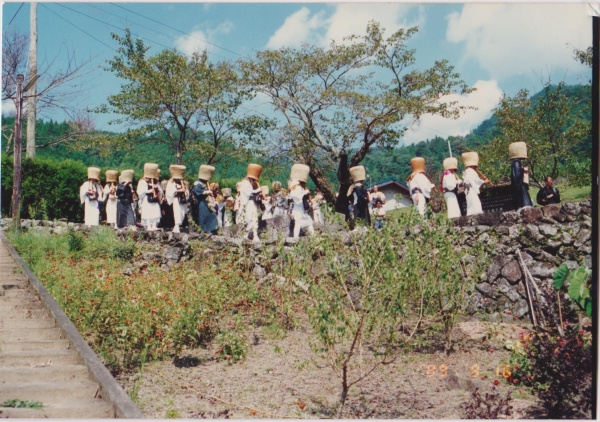
We started slow, I followed Sempai's lead. With the Tengai in place I could listen to my playing and his. Not see the people watching, or at the least ignore them better. I was pleasantly surprised we were able to play in harmony. I have heard recording of other Komuso playing and many times the tones do not match. In the Komuso world it is not supposed to matter. My Sensei also told me that in traditional Japanese music it is not about being in tune, harmonically with other players. It is more so with Shakuhachi Komuso Playing. However my musical roots come from a different place. Disharmony of tones can be an accent but not the norm. So, I was told that it did not matter, but to a musician it did. So yeah, not having to fight a tonal discord made it easier to follow the lead of Semapi on his phrasing of the Cho Shi melody.
We played first near the train station, then slowly walked toward the park, stopping every so often. People always took pictures. Being in the basket, I did not care. I was not me, who I was did not matter, what I was doing mattered and I could do it faceless. There is a Kyudo ceremony I have seen that the archer covers his face while shooting. This way it is not about the shooter but the shooting. Here it was not who was sharing the dharma, but the dharma. The Dharma in this case is the musical tones of Cho Shi.

Once we reached the park we had our first negative encounter. I was told negative encounters happen. Not always, but they are out there, where there is Yang there is Yin. This is the Tao/Do of life. Sh*t happens! they say in the street.
A security guard or sorts made us the target of his day's power trip. He basically told us we could not play there on the street in front of the Park. Even though we were not IN the park, it was considered part of the park. At least in his view. Sempai was quite surprised having been doing this for a number of years. Rather than hassle with this "rent-a-cop" on a power trip, we moved on and crossed the street. There was fewer people traffic, but it could not be helped. We walked on.

We made several stops to play after that without any further incidents. Our next encounter came from a couple of tourist girls. They said we were Co-playing. Sempai corrected them that we were in fact real priests. He was from a local temple. They were surprised and wanted pictures taken with us and them. The first of several group pictures throughout the day.
I noticed most times we stop, there was always a small crowd gathered taking pictures, even as we walked some times, pictures were common. This day much much more than donations. I was not really concerned about the donations, for me it was more about being out there. Playing and doing the practice. Turning inward and doing the song under the "Tengai" got easier as the day went on. I could block out, the photo ops crowds and just play. A couple of times a few people would get really really close like they were trying to see inside. Perhaps Chinese tourist, they are not known here for being subtle. I rolled with it. When you stand in the wind, you have to expect something to get in your eye.
One of the more difficult parts was walking and playing. That became a real challenge. There was the timing of the song, the musician me was concerned about the rhythm of walking and the playing of the song, the martial artist me was concerned about the rhythm of the breath while walking and playing. Should everything match? Meanwhile my Tengai was slipping down over my head and covering my eyes, and other parts of my Kumoso wear needed constant adjustments from slipping. Add to that some knee discomfort and foot discomfort. As with sitting Zen there was more to it than meets the eye. It is not Just sitting, it is not just playing, one as to over come distractions, internal and external. One can not attach to the distractions, one just does the practice.

I noticed during our travels, the different reactions to us. Tourist took pictures, kids pointed and had kid reactions, some just ignored us. Some of the older Japanese surprised me with their reverence. They would stop and bow. That was to me touching, not seeing me, but the spirit I represented.

One older man spoke with Semapi upon hearing us play. He said the sounds returned him to his childhood during the war. There was a legless Shakuhachi player in his town. He wanted to learn from him. However the cripple said he ( the kid) did not want to go on this path (of suffering/sadness? ). Later he was able to take lessons, but had not played in many many years. He said the spirit that we conveyed was beyond and more important than not being Japanese. I found that comforting.
In most of the tales about Komuso, it is about them wandering around playing. However it seemed the playing was about and for their enlightenment or money. They did not really do Buddhist Priest type of things. When I see and have donated to other Priest on the street they give some type of blessing to the giver. I was told when receiving a donation as Komuso, one bows and keeps playing or restarts the Cho Shi song. After the day was over, Sempai said to me, the donations you received it would be good when you got home to put it in your sacred spot and say a pray or chant over it to honor/bless those who gave. For me that struck a good cord and really gave a purpose to the collections outside of self to buy lunch or the train ticket. It was also doing something as a priest since I do not belong to a temple here or do outside charity work, here in Japan. I have not seen much of other Komusos other than for special events, so this to me gives meaning to being a Zen Priest. Something to support my vows.

Overall it was an educational and enjoyable experience. I enjoyed having a spiritual outlet for playing and being a "Ronin" priest. I have decided to do more of this and make it a part of my Lohan Chan practice. Even if nothing happens via teaching Budo and sharing dharma that way, there is this musical dharma outlet, that is not just me playing for self enlightenment. The Modern street Komuso playing touches people, more so the elders, perhaps they need it more these days, but also praying over the donations adds positive energy to the world conditions. Maybe on some level eases someone's suffering even just in their or my head having a Priest pray.
 |


 | |
| Members of the Koten-shakuhachi-kenkyū-kai, or Society for the Study of Classical Shakuhachi visited the Shimura Shakuhachi Museum in Osaka. |
 |
| A 2.0 Kogetsu from the personal collection of Higuchi Taizan. Gyokusui III looks on in the background. Komuso Mutake prepares to play an unusual chokan of Genpu Iwazimu, a komuso from the Taishō period (1912-1926) |

 |
| Playing a shakuhachi made by Watazumi, a master particularly revered in the West. |


 |
| A 6.0 shakuhachi of Genpu Iwazimu. So much caught the attention of those present that several makers afterward crafted their own 6.0s! |
 |
| Partially in view on the table, an old Myoan shakuhachi by maker Kondō Sōetsu and its 3D printer reproduction in yellow, which was very light and nearly as resonant. |
 |
| The table of shakuhachi at the maker Gyokusui III Osaka
These five shakuhachi on the left are wide bore jinashi towari 1.8s in the key of C#. An ideogram and kanji hanko by the thumbhole, and a second ideogram stamped toward the lower node of the shakuhachi are the identifiers of this Myoan style instrument. Also in the photo are boxes of recorder-like adapters for people who have never played shakuhachi, to appreciate the sound back home in the states before they start their practice of developing a proper embouchure. One's embouchure adds much tonal character.

Nara Komuso Mutake demonstrates an exceptional tonal character on an extreme large bore 1.8 jinashi shakuhachi.
|
 |
| Dakkaku |


