Dr. Kojima (Toyoaki), ISSUI/HOAN (小島豊明,一吹/保 安) is
the current abbot (Kansu貫主, pronounced “kanshu” in
the Kyoto dialect), of the Meian (aka Myōan, the older, more traditional
pronunciation of the kanji) Kyōkai association (明暗協会) , and one of its most distinguished sensei (先生) teachers. The Meian Kyōkai is one of the few
shakuhachi organisations in Japan that is dedicated solely to performances of
the sacred solo music of the shakuhachi called honkyoku (本曲). Other shakuhachi schools (ryū 流) and associations (ha派)
also revere the sacred solo literature but in addition they have highly
developed secular, “outside” music repertoire, gaikyoku (外曲), which usually receives a greater amount of
attention, thanks to its much larger repertoire and highly social contexts.
The Meian Kyōkai is rooted in the historicity of the komusō (虚無僧) who were nominal members of a Zen Buddhist sect
called the Fuke-shū (普化宗). (The other, far more
prominent sects are the Rinzai and Sōtō, names that are more familiar to
Westerners and even the Japanese.) When the komusō were not playing their
flutes on their takuhatsu (托鉢)
alms-gathering rounds, it is assumed that they would play the sacred melodies
as part of their devotional exercises within their home temples.
Many members of the Meian Kyōkai are also associated with other shakuhachi
organisations such as the Tozan ryū (都山流) but by far, the largest constituency is comprised of the Taizan ryū (男山流), founded by one of the founding fathers of the Meian
Kyōkai, Higuchi Taizan (樋口 対山, 1856 - 1914),who received the designation of 35th
abbot and the official title of KŌDŌ.
Although the Fuke-shū and its community of monks no longer exists in Japan,
following the ban of 1871 (Meiji 4), their sacred music and spirit lives on
within Kojima Sensei and the other members of the Meian Kyōkai which was
founded in Meiji 16 (1883), following the lifting of the ban against the
activities of the komusō in 1881. They are essentially lay members of a
Buddhist organisation and their activities are centralized within their own
temple named Meian-ji (aka Myōan-ji 明
暗寺), located within the precincts of the temple complex
known as Tōfuku-ji (東福寺) in Southeast Kyoto.
Their musical ethos is completely dominated by the sacred intention of most
shakuhachi players, especially in the west – to discover “self” awareness
through the application of Zen Buddhist principles of meditation and
contemplation to the performance of their flutes. Stated succinctly by Dr.
Kojima, “the playing is not like zendō (禅道),
it is zendō”.
Born in 1928 in Himeji City, Hyogo Prefecture, Dr. Kojima began his shakuhachi
training in 1951 with Tanikita Muchiku (谷北
無竹, 1878-1957) ROAN, 37th abbot of the Meian Kyōkai and
a prominent student of Higuchi Taizan, mentioned earlier. Dr. Kojima eventually
received his certification (Meian Dōshu 明暗道主) and the honorary natori (名取)
of ISSUI, in 1969 under the tutelage of the 38th Koizumi Shizan (小泉止山) RYOAN (ca. 1953-72). Since then, he has taught
continuously, including many Westerners such as myself. He was an active
participant in the activities of the Meian Kyōkai and was heard every year
at their biannual recitals (Shakuhachi Honkyoku Senkoku Kenso Taikai 尺八 本曲全国献奏大会).
His musical skills were also integral to several television productions
such as The Komusō Temple (Komusō no Tera, 1973), The Spirit of the Shakuhachi
(Fuke Meian Shakuhachi no kokoro, 1978) and Zen and Shakuhachi (Zen to Shakuhachi,
1982). His dedication to the shakuhachi and its ideals is also evident in his
magazine article “Zen and Shakuhachi”, published by Hanazono (1979, volume 29,
pp. 12-18).
In 1991 (Heisei 3) Dr. Kojima was elected to the position of the 41st abbot of
the Meian tradition. The lineage extends deep into history, past the
rejuvenation of the Meian repertoire and the formation of the Meian Kyōkai, to
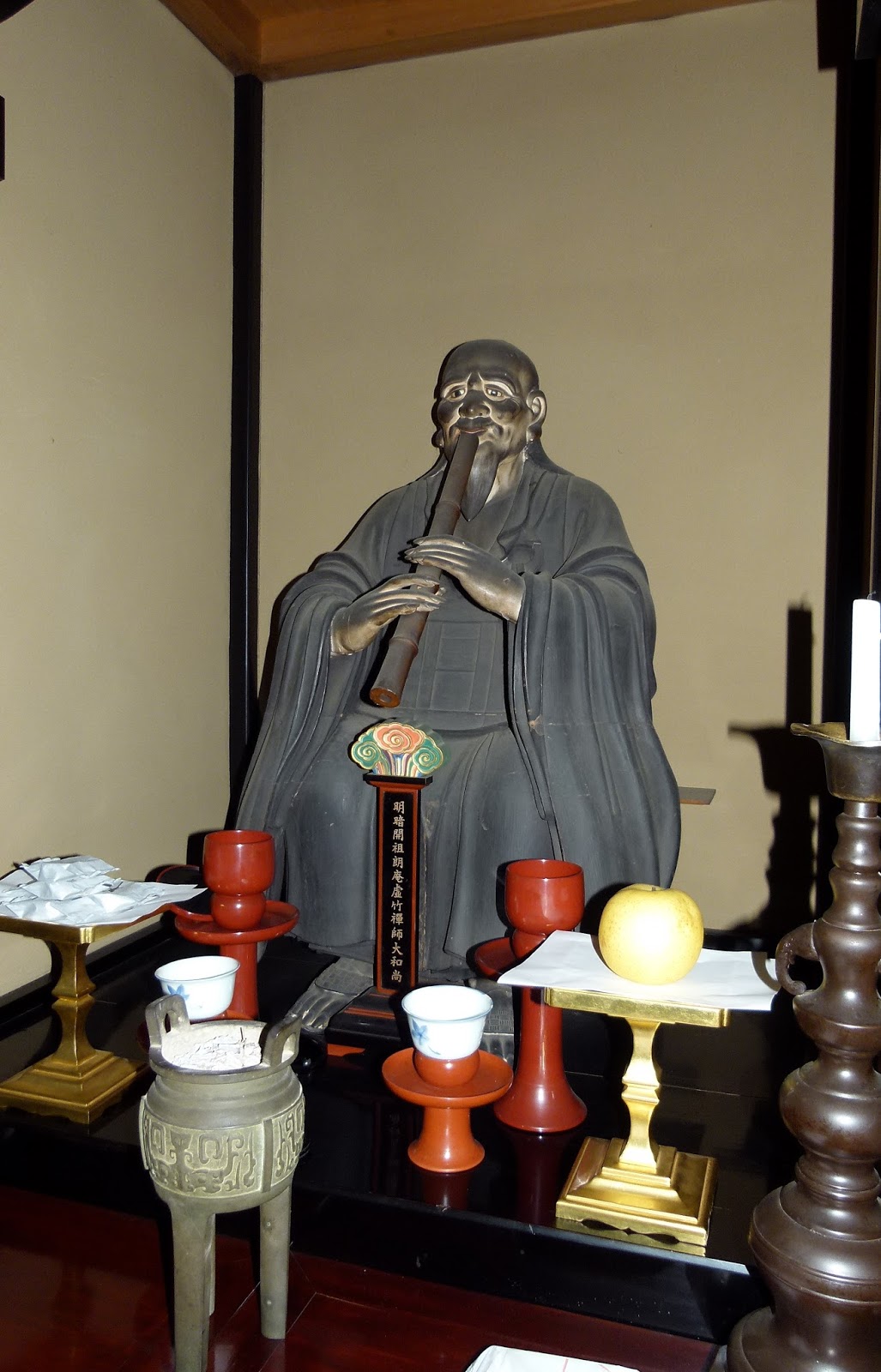
the traditional beginning of the komusō tradition by Kakushin (心地覺心, 1207–1298), now designated as the first Kansu, and
his student Kyochiku Zenshi (虛竹禅師),
Kansu 2, represented by a statue in the Meian-ji temple.
During the 2012 World Shakuhachi Festival in Kyoto, Dr. Kojima opened the
program of the Meian Kyōkai concert by playing Koku (虚空), perhaps the most revered composition of the sacred
literature. It was a very great honour and a fitting tribute to his august
position as the 41st Kansu.
As is true of all lay members of the Kyōkai, Dr. Kojima had a “day job” that
sustained his interest and dedication. He was a doctor of medicine with a long
and distinguished career at the Japan Baptist Hospital in Kyoto, specializing
in geriatric medicine. Not content with simply maintaining his medical
practice, he actively pursued research programs which resulted in several
discoveries, one of which culminated in a presentation on gastric cancer
delivered to the 6th International Cancer Congress in Florence, Italy in 1947.
He was married with four daughters and several grandchildren.
Kojima sensei was a modest, unassuming man who brought a deep intensity of
concentration to his performances of honkyoku. His style of instruction was
traditional although he did not object to the ingenuous questions of
foreigners and the use of western inquiry and dialogue, within certain contexts.
He viewed even the process of Meian instruction as a Zen discipline but, lest
the student become daunted by such single-minded dedication, the twinkle in
his eyes became instantly re-assuring. We can all be grateful for the
continuing efforts of men and women such as Dr. Kojima who nurture a living
tradition that goes beyond Japanese spiritual values to take root in the very
core of universal mankind.