Icchoken
Icchoken is a name of
Fuke sect, Komuso temple which is located in Hakata. During the Kanei era
(1624-1643), Ichio from Kyoto, Myoan
Temple came down to Hakata and
started his Komuso life in Entsu temple which at the time did not have a
priest. Since then, Icchoken has become the first Komuso temple in Chikuzen (Northern
Kyushu).
During
the time of Ikku
Ⅴ, he asked the domain for an estate in Yaguramon (Gion)
and named it “Entsuji Icchoken” which was later renamed “Fumonzan Icchoken.” In
the 4th year of the Meiji era (fiscal year 1871), Icchoken could not be spared
from the abolishment of Fuke sect. However, Icchoken revived in Daijojimaecho
(Reizen) in the 26th year of the Showa era (1951), which was then moved to Saiko
Temple in a sub-temple
of Rinzaishu Myoshinji sect,
Shofukuji.
In the main hall, we have enshrined a statue of the patriarch of Fuke sect
“Fukezenji
*” and a statue of Komuso “Kusunoki Masakatsu”. Although
Fuke sect had vanished from the public, its tradition has been inherited and it
has been designated as an intangible cultural heritage of Fukuoka
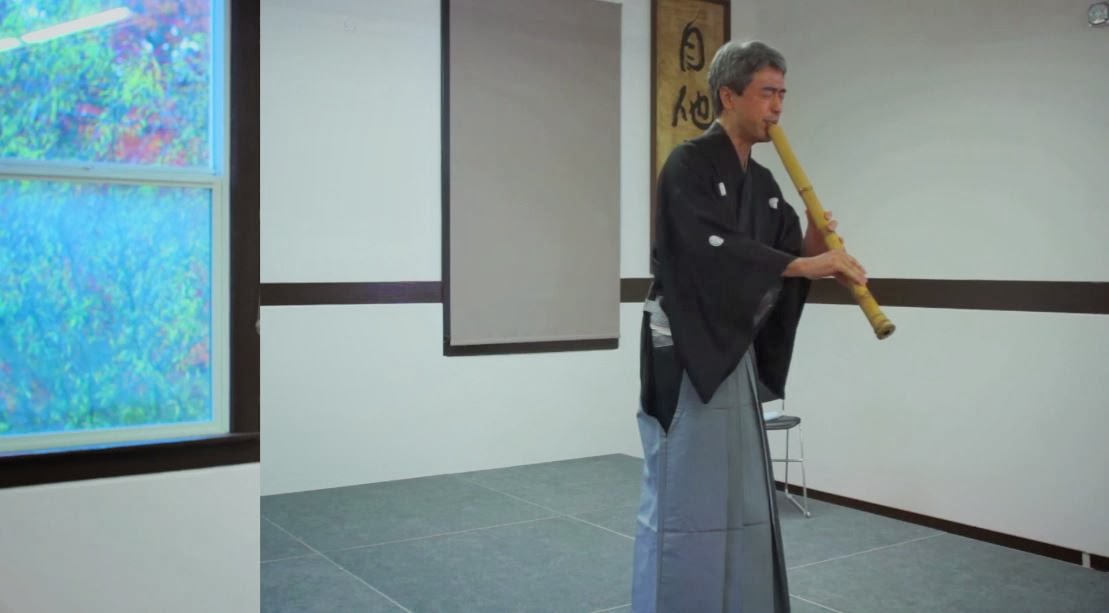
with the name of "Icchoken Denhocchiku" (Komuso's shakuhachi that has
been handed down to Icchoken) since the 40th year of Showa.
*zenji ... Zen-master
Fuke sect
Fuke
sect is a religion in which the believers play the shakuhachi, a religious
instrument, during their religious training. In other words, they believe that
playing thoroughly every sound of the shakuhachi makes you reach enlightenment.
Their first ancestor was Fukezenji who had a connection with Rinzaizenji
during the Tang dynasty of China.
Fukezenji's apprentice was charmed by the sound of the bell his master rang at
the time for religious meditations, so he recreated the sound with the
shakuhachi. That was the beginning of this religion. It was brought to our
country by Shinchi kakushin who went to Sung during the Kamakura Period.
“Kyotakudenkikokujikai” (Fuke sect's origin that was written during the Edo
period)
Fuke
sect reached its peak during the Edo Period. However, it was abolished by the
Restoration Government on the 4th year of the Meiji Era as the religion was
strongly related to the Edo Shogunate. The origin of “Kyotaku Denki” is said to
be a fiction, but the history and tradition of that one sect have been passed
from generation to generation until today.
Komuso
Komuso
means Fuke-Buddhists who play shakuhachi at the time of religious mendicancy.
Kusunoki Masashige, a warlord who was active during the period of the Southern
and Northern courts, had a grandson named Kusunoki Masakatsu. When he was in
Sung he played the shakuhachi and went on a pligrimage by the name of “Komu”
which is responsible for the name “Komuso”. Another origin could be “Komoso”
who wrapped a mat woven with rush around their waist during religious
mendicancy and their name has gradually been changed. Apparently they were also
called “Boronji,” “Boroboro,” “Boro”.
In
the Edo period, Fuke sect was established well and
Komuso started to provide three items (Shakuhachi, Kesa, Tengai) and three
signatures (Honsoku, Kaiin, Tsuin). Komuso are people that have escaped from
the world and have become Anchorets, so they considered each other as brothers.
When they crossed the world of dust they were given a tengai, a deeply woven
straw hat in order to avoid getting dust in their eyes from the wind. Tengai
has woven windows called Doko (pupil) so that they can see the outside world
easily, but apparently, tengai of Icchoken's Komuso did not have Doko until the
Meiji Restoration.
Three
signatures include Honsoku, a document of fundamental dogma, Kaiin, a
certificate of being a Fuke-Buddhist, and Tsuin, a passport that allows you to
go on a pilgrimage.
When Komuso met each other, it was a rule to show those
three signatures to distinguish fake Komuso. Also, keeping their tengai on was
a manner during the religious mendicancy no matter how royal people visited. It
was considered rude to show their face. Although Komuso disappeared due to the
abolishment of Fuke sect in the 4th year of Meiji, religious mendicancy of
Komuso has revived after Komusodera (temple with Komuso) gained formal
acceptance as a religious corporation in Showa.


.jpg)




.jpg)
.jpg)


