Wednesday, July 21, 2010

Shakuhachi Woodblocks


Hero Warrior Monk


Dandy
Flowers and Cuckoo.


Otokodate

Friday, July 16, 2010

Young Watazumi Doso Roshi

Born in 1911 as Tanaka Masaru.
Founder of Ichoken Fukko-ha, also known as Myoan Masho-ha.
Writing in photo can translate as "hochiku Watazumi religion."

Saturday, July 10, 2010

Monday, July 5, 2010

New Invention for Precious Metal Calligraphy on Urushi

Sensei Morimasa Horiuchi and I attended a lecture by Professor Yutaro Shimode from the Kyoto Institute of Technology.  He has recently invented a paint that's available in 24 K gold or silver.  It layers well onto urushi and other finishes, drying instantly and durably.  Sensei Morimasa Horiuchi tried Professor Shimode's gold maki-e brush/pen/stylus to paint his Taizan name "Sei Sui" with the year dated 2010 on a Yuu from my knapsack.  Beautiful results!
The gold maki-e lacquer improves the sound of this Yuu by 7.53%  ;-)


Yutaro Shimode is the 3rd generation of lacquer craftsmen (Makie Shisho) born in the ancient capital of Kyoto in 1955. The Japanese lacquer (Urushi) is a natural substance obtained from the urushi tree, which is often used to coat wooden products to impart surface glossiness. Specially lacquered (Makie) products made by Shimode included fixtures and altar furniture used in various shrines and temples throughout Japan. In 1993, during the 61st renewal of the Grand Imperial Shrine in Ise, Shimode was involved in the restoration and renewal of specially lacquered sacred ornaments that were enshrined. About 60 pieces of Makie wares augment the interior decor of the Kyoto State Guest House, which was built for the purpose of welcoming guests from abroad and also as a gesture for deepening of friendship between the guests and Japan. These carefully selected wares were sprinkled with flecks of gold or silver that exemplifies the rich tradition and excellent Japanese craftsmanship. Moreover, these Makie wares have been chosen as exhibits for 24 consecutive years at the Japan Fine Arts Exhibition, which is the most popular major art exhibition in Japan. A commemorative Makie lacquer box souvenir was specially crafted by Shimode and given as a symbol of friendship to U.S. President Obama during his visit to Tokyo in November 2009.


Throughout the years, Shimode has been conducting various courses and training workshops to encourage the young generation to inherit the skills and knowledge of the traditional art of Urushi making. Shimode was appointed as an adjunct professor at the Future Applied Conventional Technology Center of Kyoto Institute of Technology since 2006 where he conducted various researches concerning the quality of Urushi products and developed methodologies to assess the transferring of traditional skills from professional to amateur craftsmen. Shimode has received numerous state awards in recognition for his excellent contributions towards the preservation of the art of Urushi.
 
Prof. Yutaro Shimode
Future-Applied Conventional Center
Kyoto Institute of Technology

Maki-e Lacquer Maestro Shimode-san graciously gave me a bamboo leaf pattern he painted and signed  after the lecture on a piece of urushi paper.   Domo arigato, Shimode-san!


New Release of Watazumi's Oldest Recordings

1935-1945  (beginning 24 years old through 34 years)


Sunday, July 4, 2010

4 Bells for the Fourth

(click on the following link, and turn up the volume to hear the birds in the background)

Oldest Temple Bell in Japan  http://www.opendrive.com/files/6594056_AX7pQ/bell%201.mp3


Japan's oldest temple bell ringing four times for today's Yankee Independence July 4th celebration. The suspended soft wooden shuro-no-ki log gently strikes the cast bronze bell of Kanzeon Temple. The bell was first rung in 698 A.D., and after 1,312 years still tolls ... Wow.


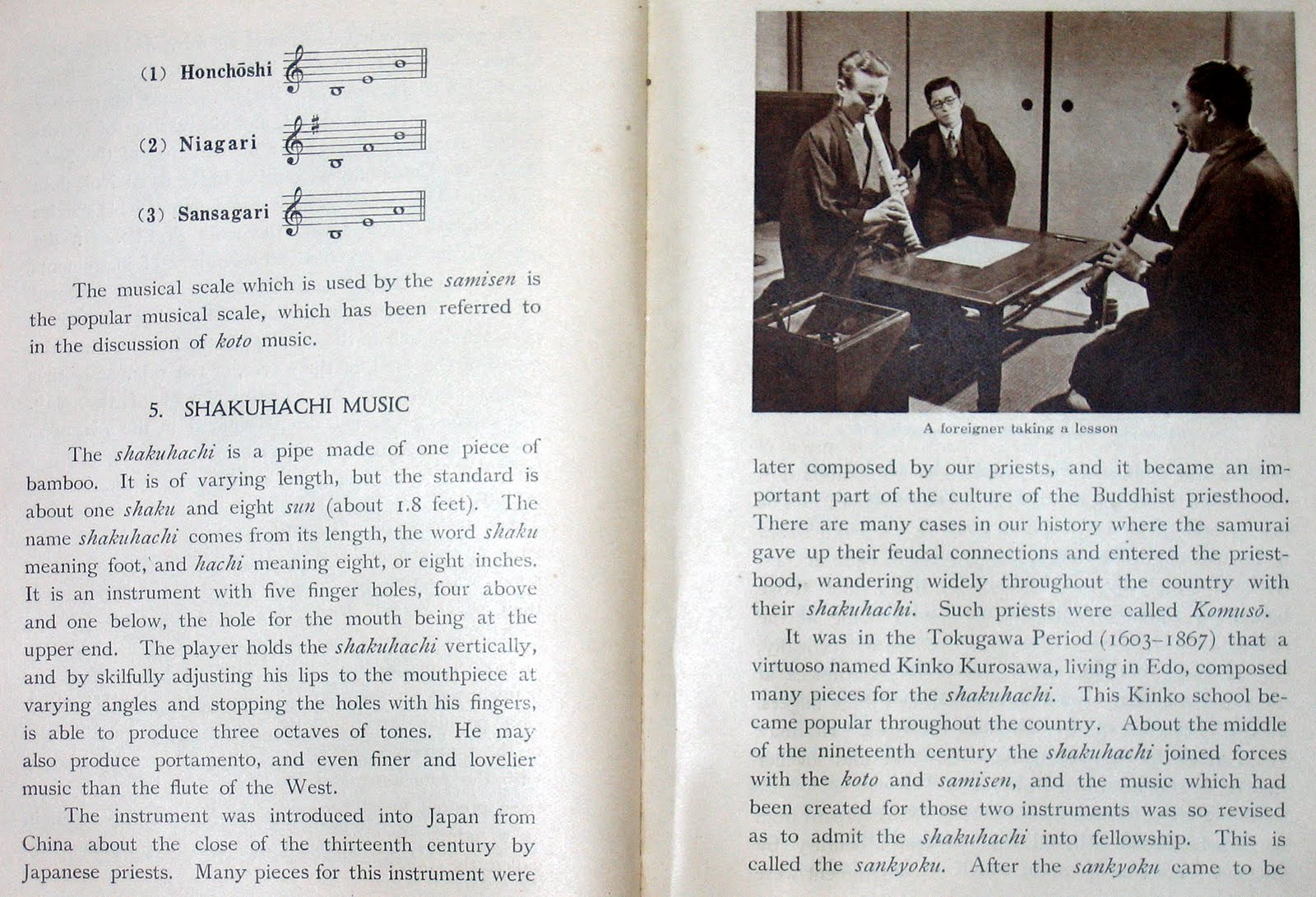
Japanese Music

By Katsumi Sunaga; published September 1936.


What types of Foreigners learn the shakuhachi, why, and to what end?

Have a Happy Yankee Independence Day :-)

Monday, June 28, 2010

Komuso Scroll

Whence?

Kyozan-bo

Yushin (left) and unidentified player at Tomimori Kyozan's school.

Tuesday, June 22, 2010

Japan Today, One Moment Long Ago


Library Komuso

 
Nice photo of a komuso in tengai and foliage.
The title graphic and library sticker further obscures his anonymity.

Ma: The Expression of Silence and Space


{double click for full image}


The Uses of Not

Thirty spokes meet in the hub,

but the empty space between them

is the essence of the wheel.

Pots are formed from clay,

but the empty space between it

is the essence of the pot. 

Walls with windows and doors form the house, 

but the empty space within it

is the essence of the house.
 
                            --Lao Tse


Monday, June 21, 2010

Nara Temple Musician

Recording Shakuhachi

                                 with Elizabeth Reian at Tufts' Distler Hall

Komuso: monks 僧 of empty 虚 nothingness 無


In Edo Culture: Daily Life and Diversions in Urban Japan, 1600-1868 by Nishiyama Matsunosuke.

On page 124 the author says: "These monks formed an association that functioned as a kind of relief organization for masterless samurai. The way of the komusō was an honorable calling. As a member of the warrior class , a komusō might theoretically be summoned to rout an enemy. Komusō were thus granted freedom to travel anywhere they pleased. They were given the right to use ferries free of charge and even attended the theater without paying admission. Komusō often misused their privileges, however, and were known to wreck havoc on the road or in the villages through which they passed. The bakufu responded to such behavior by repeatedly issuing various prohibitions.

Komusō were required to tour either alone or in pairs; no large groups of komusō roamed the land during the Edo period. Moreover, komusō were not allowed to stay at a location for longer than a day; nor did they have the right to use horses or palanquins. The komusō were, however, never required to remove their basketlike hat. No matter how exalted a presence they might encounter on the road or at an inn, they were not obliged to show their faces. Hence on both the roads and at inns, komusō were highly conspicuous."


Requiem

                                      Honkyoku Transcendance
Ken Ko San
Remembrance
Family Shrine
Horiuchi Crest

Tuesday, June 15, 2010

Grand Sensei Tomimori Kyozan and Ken Ko San

Grand Sensei Tomimori Kyozan (1899-1975) favored the original requiem honkyoku Ken Ko San.  This treasured honkyoku became a tradition for the students of his school.  Yushin has emailed that Ken Ko San was an original old honkyoku from the Soetsu school.


Ken Ko San is Sensei Morimasa Horiuchi's favorite honkyoku in the Taizan-ha repetoire. 

The feeling within this and many other honkyoku honors the spirits of the departed.  

Ralph Samuelson has shared that one of his favorite honkyoku combinations is Hi Fu Mi followed by Ken Ko San.

Saturday, June 12, 2010

Sunday, June 6, 2010

Myoan-ji 1960s


Connect the Stars...

into a Constellation of Sound.